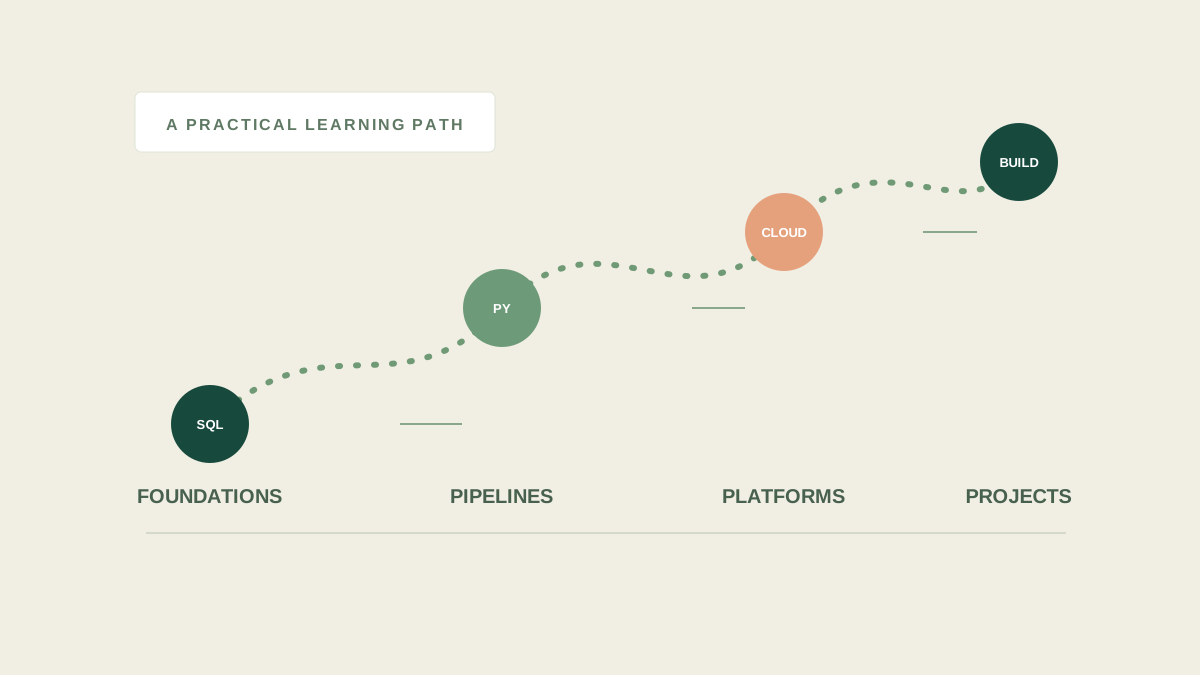
A data engineering roadmap is a sequence of capabilities, not a checklist of products. Build a strong foundation, connect it to a small end-to-end workflow, and deepen platform knowledge as the problem requires.
Start with data and code fundamentals
- SQL: filtering, joins, aggregation, window functions, and reasoning about query results.
- Python: functions, collections, file handling, APIs, JSON, exceptions, logging, and tests.
- Data modeling: grain, keys, facts, dimensions, and the difference between source-shaped and analytical data.
Learn how pipelines move and shape data
Understand ETL and ELT, batch versus streaming, full loads versus incremental loads, and how to preserve a trustworthy checkpoint. Practice validating schemas and business rules before publishing data to downstream users.
Add platforms and distributed processing
- Learn one cloud platform's identity, storage, networking, and operational foundations.
- Explore a warehouse such as Snowflake and understand how storage, compute, and access controls fit together.
- Study Spark and PySpark when data volume or transformation patterns call for distributed processing.
- Choose an orchestrator and learn dependencies, retries, scheduling, and run monitoring.
Build operational habits
- Version SQL, Python, and pipeline configuration with Git.
- Use CI/CD checks to validate changes before deployment.
- Monitor freshness, run duration, row counts, failures, and data-quality results.
- Make retries safe and document how to investigate and replay a bounded failure.
Prepare to explain your decisions
Practice describing the business need, source data, architecture, trade-offs, quality controls, security boundary, and what you would monitor. Use projects to turn abstract concepts into a clear technical story.
Share this article
Continue your learning journeyExplore Interview Support